
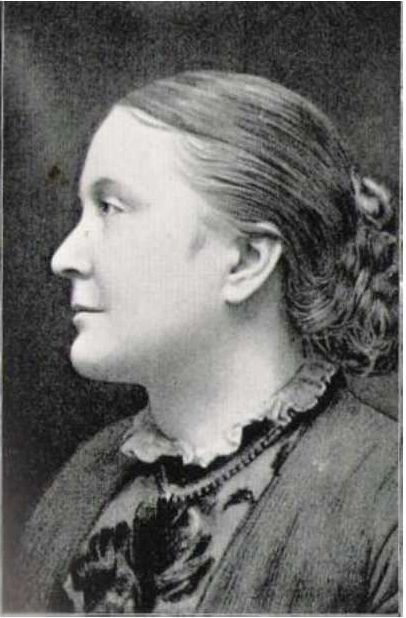
Mary Elizabeth Townsend

Mary Elizabeth Townsend at age 32

23rd July 1841— 14 June 1918


23rd July, is the anniversary of our GFS Founder’s birth — born on this date in 1841.
Let us just pause here a moment to set the scene and ponder a little on what we know of England at that time in 1841.

  • It was a celebratory year – the year that the young Queen Victoria, aged 22, married her beloved Prince Albert who came from a small German Principality which existed at the time.
  • A new phenomenon called “taking a likeness” (later called photography) was being experimented with.
  • The streets of London and major cities were being lit with gas lighting making them brighter and much safer after dark.
  • Some short single line railways were in operation.
  • It was a place of great contrast – enormous wealth for some who had become rich living off the proceeds of American slave plantations but abject poverty for many others.
  • It was the so called “exciting times” of the Industrial Revolution. Young people flocked to the cities for work, but found no excitement – only loneliness, long hours, low wages, hunger, danger and exploitation.

Now let us get back to Mary – Mary Elizabeth Butler was born in St. John’s Vicarage, Kilkenny, Ireland, daughter of the Rev. Robert Butler and his wife Grace (nee Hamilton). Her parents were both from strong Christian and church backgrounds but, sadly, both parents died when Mary was quite young and she was sent to England to be raised by two aunts, (her father’s sisters) who provided for her and gave her what education and Christian upbringing they could.

Mary proved to be a considerably talented child with a great love of literature, a proficiency in languages, music and art, all of which she utilized throughout her life writing books, translating, and producing sculptured and artistic works.

At age 22 she married Frederick Townsend in 1863, an artist and botanist, almost twice her age, and who bore the title “Squire of Sheffield”. After marriage they went to live at Sheffield Hall (still standing today and in use as an Aged Care Home). It was a happy and productive marriage and Mary was known to have said that “she put herself in his hands, and was happy to grow and develop under his care”, both Frederick and Mary worked to improve the lives of people living and working on the Estate. Mary concentrated on the education of girls, the Orphanage, and the care of the elderly.

Enter the Bishop of Winchester whose name was Samuel Wilberforce and who was the son of WILLIAM WILBERFORCE (great Christian, Member of Parliament, and main Spokesman in the House of Commons arguing relentlessly, and finally successfully, to bring about the Bill for the Abolition of Slavery in 1807, although the slavery market continued on well into the 19th century. It was found very hard to control, and took quite a time to be completely eliminated).

Samuel Wilberforce, Bishop of Winchester became alarmed at the large number of girls appearing before the Courts charged with stealing food! He had heard of Mary’s interest, concern, and her individual efforts. The Bishop wrote to Mary inviting her to a meeting at Lambeth Palace London, (official residence of the Archbishop of Canterbury) to discuss the situation and what might be done. A committee of five people was formed (later called “The Historic Five”) who became impressed with Mary’s ideas, suggestions and recommendations on the need for structure and organisation.

Further meetings and discussions finally saw The Girls Friendly Society established and begun officially on 1st January 1875. It grew rapidly and became enormously successful. Membership was necessary. It received the Royal patronage of Queen Victoria and by the end of the century had more than a quarter of a million members. The Society was non-denominational although it used the structures of the Church of England.

The official history, published in 1911, shows clearly that Mary Townsend was the driving force behind GFS. Men of all classes had their Clubs, Benefits and Associations. She had now extended this to girls and women. She was the first President of The Girls’ Friendly Society. Accommodation was vital. Premises were acquired and lodges (later called hostels) were established where educational and domestic skills were taught along with the gospel message. The organisation flourished and subsequently became world – wide as it remains today.

Also, in 1875 Frederick Townsend received an inheritance from an uncle – Honington Hall, a 17th Century Estate near Shipton-on-Stour, in Warwickshire, where they lived from that time onwards. Mary continuing her GFS work and other interests – Frederick becoming a Conservative Member of Parliament for Stratford-on-Avon until 1892, passing away in 1905 at the age of 82 years, with Mary herself passing away on 14 June 1918 aged 77 years. Both are buried in All Saints churchyard in Honington, Warwickshire, England.

Little else is known or recorded of Mary’s life and we must leave her here with some measure of “privacy” of life to which we are all entitled, and give thanks to God for her steadfast faith and commitment to her Lord, her dedication to the task, and the great benefit women over the last 147 years have derived from fellowship in GFS and are still doing so today in their various countries.

In conclusion – In a secular world, this would be the time for us to stand and announce a toast to our Founder on her birthday, but for GFS members it is more fitting to stand and give thanks to our Heavenly Father for her life and work in which we all participate and enjoy to-day.

Thanksgiving Prayer

Gracious Lord, We thank you for the life of Mary Elizabeth Townsend who, although having an earthly life with many creature comforts available to her, chose rather to spend her time and energy in service to those around her who were critically in need of guidance, care, safety, and the message of salvation through our Lord Jesus Christ.

We thank you for the benefits we receive, so many years later, through her tireless efforts in establishing our GFS Organisation, and may we also be inspired and renewed in our daily endeavours to serve you and others throughout the world, with our GFS Sisters in Christ, and always live to bring honour to you — through Jesus Christ our Lord.

Amen

Townsend Song


Townsend, Townsend, this is the group for you,
We’re ex Leaders, Members and Juniors too!
Dear Mary was our founder,
G.F.S. was built around her,
We will always be there,
With our friendship to share
Townsend ladies welcome you!

(Sung to the tune of Daisy, Daisy)

GFS Sydney Resources

For all GFS leaders, God is our primary source of inspiration. We hear God’s word from the Bible.

1 Corinthians 12:4-6 (Living Bible)

“Now God gives us many kinds of special abilities, but it is the same Holy Spirit who is the source of them all. There are different kinds of service to God, but it is the same Lord we are serving. There are many ways in which God work in our lives, but it is the same God who does the work in and through us who are his.”

Leaders need fellowship. You will also gain resource and inspiration from:

            Your family

            Your friends

            Your daily life

            The girls and leaders in your GFS branch

            Your rector

            Fellow parishioners

            GFS members from your diocese, other dioceses or even other countries   

GFS Sydney website provides many resources in the “Members Area” under the heading “Resources”. You will find:

There is a separate section with resources for Playgroups. It contains ideas for:

Other Resources

  • GFS Websites for GFS Australia, GFS World and other GFS diocese’s and country’s websites
  • Sunday School and Scripture Teachers have teaching aids that you may be able to borrow.
  • School teachers can tell you all sorts of valuable information.
  • Libraries contain so many resources not only books but some have toy libraries or other equipment that can be borrowed for a time period.
  • People with special talents eg Doctor or nurse to talk about health, Gardener to learn about cultivation, an artist to learn painting, dressmaker to teach sewing, vet to learn about taking care of animals, etc And don’t forget the mothers who can cook, sew or jump rope.
  • Other organisations in the Parish like MU, Playgroup, etc
  • Your Rector
  • Other Training sessions / Workshops such as First Aid, Youthworks courses, etc

Further Training

GFS encourages all leaders to continue their training. One way we do this is by offering the Deeth Award

  • This award is named in honour of Maggie and Doug Deeth, a committed Christian couple who dedicated their lives to children’s ministry through GFS both at branch and diocesan level.
  • The Deeth Award is up to $500 per annum to assist GFS members/girls who would benefit from courses/events available in the Diocese. The award can be given to more than one person each year. For example $100 could be given to each of five people in a given year.
  • Please apply via the application form

Once you have read through the GFS Sydney Resources section, please do a simple test.

GFS Sydney Resources Test

Congratulations you have now completed the GFS Leader Training Workshop!

Please Contact Us to get your results and certificate.

Programming for a Branch meeting

What is a programme?

  • A programme is a tool to be used by the leader/group.
  • A programme should provide you with a general outline of your teaching goals, learning objectives, and means to accomplish them. It is a reminder of what you want to do and how you want to do it. There are many ways a programme can be portrayed – One way is a Run sheet – GFS provide a Run sheet at the start of each GFS published programme. Another way is to have a programme book.
  • A GFS Programme aims to help girls develop as a whole person and thus provides for emotional, mental, physical, social and spiritual development.
  • Programmes must stem from the needs and interest of the girls in the group. Activities planned should consider their age, skill level, interests, physical limits, etc. There must be balance and variety in a programme.
  • A good GFS programme helps girls/women’s experience Christianity in the whole of the programme and thus in life.
  • Remember Jesus Christ’s desire to lead each person into a closer personal relationship with God.
  • An excellent programme should:
    • Widen girls/women’s experience
    • Open the mind to Christian attitudes
    • Gain new understanding
    • Improve/develop skill level
    • Increase knowledge
    • Develop Christian character

Stages of a Programme

  • Planning
    • Aim – Depends on the needs of the girls/women in the branch
    • Purpose – Why are we doing this?
    • Planned Activity – What can be done?
    • Resources – What is available that we need?
    • Other considerations
  • Carrying out
    • Preparation
    • Practicing
    • Doing
  • Evaluation
    • Did it work?
    • Was it good?
    • Did it accomplish anything?
    • Improvements?

How to Plan a Programme

 1. Outline objectives

            What is the topic of the meeting?

            What do I want girls to learn?

            What do I want them to understand and be able to do at the end of meeting?

            What do I want them to take away from this particular meeting?

Rank activities in terms of their importance. This step will prepare you for managing meeting time and accomplishing the more important learning objectives in case you are pressed for time.

            What are the most important concepts, ideas, or skills I want girls to be able to grasp and apply?

            Why are they important?

            If I ran out of time, which ones should not be omitted?

            And conversely, which ones could I skip if pressed for time?

2. Identify the content

Design the specific activities you will use to get girls to understand and apply what they have learned.

Because you will have a diverse group with different academic and personal experiences, they may already be familiar with the topic. That is why you might start with a question or activity to gauge their knowledge of the subject or possibly, their preconceived notions about it.  When you have an idea of the girls’ familiarity with the topic, you will also have a sense of what to focus on.

Develop a creative introduction to the topic to stimulate interest and encourage thinking. You can use a variety of approaches to engage girls (e.g., personal anecdote, historical event, thought-provoking dilemma, real-world example, short video clip, posters on the wall, practical application, probing question, etc.). Consider the following questions when planning your introduction:

            How will I check whether girls know anything about the topic or have any preconceived notions about it?

            What are some commonly held ideas (or possibly misconceptions) about this topic that girls might be familiar with or might espouse?

            What will I do to introduce the topic?

3. Required Resources

You may need a variety of resources to conduct your programme. You could need a specialist who is more knowledgeable of the topic such as a nurse. Or you may need specific equipment to conduct an activity such as craft supplies or a story board. It is important to consider assistance from others for knowledge and equipment. You may be surprised at what other’s have and are willing to share.

      Who may know more about this topic?

      What specific equipment do I need to help explain this idea?

4. Plan the specific learning

Prepare several different ways of explaining the material (real-life examples, analogies, visuals, etc.) to catch the attention of more girls and appeal to different learning styles. As you plan your examples and activities, estimate how much time you will spend on each. Build in time for extended explanation or discussion, but also be prepared to move on quickly to different applications or problems, and to identify strategies that check for understanding. These questions would help you design the learning activities you will use:

            What will I do to explain the topic?

            What will I do to illustrate the topic in a different way?

            How can I engage girls in the topic?

            What are some relevant real-life examples, analogies, or situations that can help girls understand the topic?

            What will girls need to do to help them understand the topic better?

5. Check understanding

How will you know that girls are learning? Think about specific questions you can ask girls in order to check for understanding, write them down, and then paraphrase them so that you are prepared to ask the questions in different ways. Try to predict the answers your questions will generate. Decide on whether you want girls to respond orally or by writing.

            What questions will I ask girls to check for understanding?

            What will I have girls do to demonstrate that they are following?

            Going back to my list of learning objectives, what activity can I have girls do to check whether each of those has been accomplished?

An important strategy that will also help you with time management is to anticipate girls’ questions. When planning your programme, decide what kinds of questions will be productive for discussion and what questions might sidetrack the group. Think about and decide on the balance between covering content (accomplishing your learning objectives) and ensuring that girls understand.

 6. Conclusion

Go over the material covered by summarizing the main points of the programme. You can do this in a number of ways: you can state the main points yourself (“Today we talked about…”), you can ask a girl to help you summarize them, or you can even ask all girls to write down on a piece of paper what they think were the main points of the meeting. You can review the girls’ answers to gauge their understanding of the topic and then explain anything unclear during the following meeting. Conclude the meeting not only by summarizing the main points, but also by previewing the next meeting. How does the topic relate to the one that’s coming? This preview will spur girls’ interest and help them connect the different ideas within a larger context.

7. Create a realistic timeline

It is easy to run out of time and not cover all of the many points you had planned to cover. A list of ten learning objectives is not realistic, so narrow down your list to the two or three key concepts, ideas, or skills you want girls to learn. Instructors also agree that they often need to adjust their lesson plan during the meeting depending on what the girls need. Your list of prioritized learning objectives will help you make decisions on the spot and adjust your programme plan as needed. Having additional examples or alternative activities will also allow you to be flexible. A realistic timeline will reflect your flexibility and readiness to adapt to the specific room environment. Here are some strategies for creating a realistic timeline:

  • Estimate how much time each of the activities will take, then plan some extra time for each
  • When you prepare your programme plan, next to each activity indicate how much time you expect it will take
  • Plan a few minutes at the end of group to answer any remaining questions and to sum up key points
  • Plan an extra activity or discussion question in case you have time left
  • Be flexible – be ready to adjust your programme plan to girls’ needs and focus on what seems to be more productive rather than sticking to your original plan

Be diary wise about other events such as special parish dates, public holidays, community events, other GFS activities or seasons before planning to avoid clashes.

Here are some things to keep in mind when planning a programme

  • What is the aim of the group?
  • How many girls in the group?
  • What are the needs, interests and problems of the group?
  • What is the purpose of the programme? (Why do this?)
  • Does this fit in with the overall programme of the branch?
  • Are there any important dates to be aware of? School holidays, public holidays, events at school, in the parish, in the community, in GFS?
  • Is the activity worthwhile?
  • Does the programme help the girls develop their relationship with God?
  • Is it possible?
  • Is the programme balanced and relevant to the girls?
  • Is there enough/too much variety?
  • Are resources available?
  • What facilities available for the group?
  • Are the girls interested?
  • Is it within the ability of the group?
  • How long will it take?
  • Do we really know what we are doing?
  • Who can help?

Presenting the Programme

In presenting and doing the programme, remember –

You are the Leader in partnership with the girls so

  • Give every opportunity for the girls to organise, carry through and be responsible for as much as possible.
  • Do not underestimate the ability of the girls – give them a chance to prove what they can do, and to learn and grow through doing.
  • Remember your attitude towards their abilities is very important;

                  – your enthusiasm will be infectious;

                  – your own example will set the tone of the meeting;

                  – your influence will have a lasting effect on the girls.

 Evaluation

Evaluation is reflecting on your programme plan, It is a comparison of what happened compared to what you planned.

It should not be difficult and should not take long. A programme may not work as well as you had expected due to a number of extraneous circumstances.

You should not get discouraged.

Take a few minutes after each meeting to reflect on what worked well and why, and what you could have done differently.

It is important to evaluate and identify successful and less successful organization of time and activities will make it easier to adjust at another time.

  • Was the aim clear and was it achieved?
  • Did the programme meet the needs of the girls/women?
  • What helped and what hindered?
  • Did we need more help?
  • What should we avoid in future?
  • Was there any new ideas for future programmes?
  • What did we learn?
  • What worked well?

Programme Ingredients

Christians learn through living.

  • Themes – some programmes are based on themes and can be planned over a term or a few weeks.
  • Variety in activities stimulates both the leader and the learner.
  • Physical limitations also need to be considered when deciding the activity.
  • Activities for a GFS programme may include a wide variety of ideas.  Such as:

      – Talking and listening eg Story-telling, Discussions, Worship services, Praying, Plays, Poems, Witnessing

      – Sight and Sound eg films, radio, Pictures, Flannel boards, flash cards, diagrams, models, Puppets, Musicals, Mimes, Dance, Singing

      – Physical Activities eg Games – indoor, outdoor, team, individual; Swimming, Visiting, Archery, Cycling, Excursions, Horse riding

      – Mental Activities eg Puzzles, Jigsaws, Mazes , Find-a-word (Word search), Crosswords, Connect the dots, Colouring-in, Spot the Difference

      – Life Skills eg Grooming, Health care, Money matters, Entertaining, Cooking, Road safety, Gardening, First aid, Visiting/Helping others

      – Arts, Crafts and Hobbies eg Drawing, painting, Photography, Pottery, Sewing, Knitting, Stamping, Screen printing, Weaving

      – Outdoor adventures eg camping, hikes, camp fires, climbing

The list goes on.  GFS Sydney has a variety of ideas for leaders to use on our Resources page. Use your own imagination and creativity to design programmes for your group.

Once you have read through the “Programming for a Branch meeting” section, please do a simple test.

Programming for a Branch meeting Test

Next is the GFS Sydney Resources section

GFS Branch Organisation

There are many types of branches/groups depending on the girls/women/children who attend. A branch may hold leader meetings to organise the programme for the coming term. Branch meetings may be held weekly, monthly or at appropriate times for all members.

There should be a Leader-in-Charge who guides the branch meetings with the help of other members/leaders/helpers.

Branch Record keeping

Leaders of GFS branches need to keep records. There are 3 types of records: financial records (how much money your branch has and how much it spends); legal or operational records (information about members of your branch who attended meetings/events, and what was done during meetings/events); and other records that help run meetings. A good record keeping system will help you track performance and assist you when reporting. It will become a good historical record to refer to in the future.

Financial records

Your branch’s financial records allow you to track your cash flow, prepare your annual financial report to the parish council and understand your overall financial position. They can include documents such as:

  • receipts and invoices for goods and services
  • petty cash book
  • bank statements.
  • a register of your branch assets
  • depreciation schedules
  • documents showing how the branch is financed e.g. any branch loans

Financial records are generally kept by the Treasurer or Leader-in-Charge of the branch. All monies received and paid out should be accounted for. A record of such finances must be kept. The financial documents are necessary to ensure that the branch’s funds are sufficiently accounted for and to avoid any possible argument about them. A bank account should be opened for the branch to operate with at least 2 signatures OR the church may request the branch to operate out of the church’s petty cash. Financial statements should be prepared yearly for the Parish council.

Legal records

Legal records are documents that relate to the operation of your branch. These documents can include:

  • Branch registration documents which contain contact details, such as addresses, phone numbers, emergency contacts, child health record and parent contact details, dates of welcoming, enrollment, admission. This may also contain dates such as when a member leaves the branch, birthdays, etc. It may also include Permission forms. GFS Sydney each year create a Registration/Permission form for use by branches.
  • Attendance book/lists are a record of weekly meeting attendance and weekly subscription if applicable. GFS Sydney create a GFS Branch Sign On/Out sheet and also a Kidsplus Sign On/Out sheet and a Playgroup sign On/Out sheet.
  • Rules, policies and procedures Some branches make their own rules, policies and procedure which outline how leaders and members will manage the day-to-day operation of the branch. Some branches use their church’s policies and procedures. These documents may include:

work place health and safety plans
dress standards
reportable conduct policy
privacy policy
operation manuals

It’s a good idea to provide all leaders in a branch with a copy of any rules, policies and procedures when they join the branch.

Note: Privacy and security of personal information

Australian privacy laws apply to the collection, use and storage of personal information. Personal information is information that could identify who someone is. Some examples are name, address, telephone number, date of birth, and bank account details.

It is essential that all personal data is kept securely.

Other branch records

It can also be a good idea to keep other records for reference in the future such as:

  • Branch Team management meeting decisions/minutes
  • Programme book or Run sheets. This is the plan for the activities of branch meetings and will include an evaluation of the success, failure or suitability of the activity to be completed after the meeting. Attached is an example of a Run sheet.
  • Incident book – for reports of any accident / incident
  • Annual Reports which should be sent to your parish Council and to GFS Sydney

How long should you keep records for

You need to keep your records and documents for different amounts of times depending on the government department or organisation that needs the information. Generally financial documents need to be kept for 7 years.

How should you keep your records

There are a range of methods and tools you can use to keep records for your branch. You can keep your records either electronically or in paper (hard) copies. There are benefits to both.

Paper copies

Paper or hard copies of records are often the original copies of your documents.

The advantage of keeping the original records is that they’re sometimes required if the record is used as evidence in legal matters. Paper copies of records can also be used to support any electronic records if there is dispute over the electronic copy.

If you are keeping paper copies of your records however, it’s important to store them properly, as they can:

  • often be misfiled
  • take up a lot of storage space
  • decay over time or be destroyed by water or excessive sunlight.

Electronic copies

Electronic copies of records are now generally accepted by government departments.

To keep your records electronically, you must make sure they are a true and clear copy of the original. The records must also be on a computer or device that:

  • you have access to (including all passwords)
  • is backed up in case of computer failure
  • allows you to control the information that is processed, entered and sent.

Advantages of keeping electronic records include:

  • records can be easy to search and easy to create filing systems for
  • it is easy to create additional copies of records
  • there is software available to help you with keeping electronic financial records
  • electronic records requires less physical storage space than paper records
  • certain apps will allow you to create records on the go and organise them from your mobile device.

Disadvantages to keeping electronic records include:

  • if the data is kept on a hard drive or USB device, it can be lost or susceptible to data corruption
  • needing additional security to make sure that the information on the records is protected from computer viruses or people gaining unauthorised access
  • hard copies might still be needed for legal and other uses.

If you decide to keep electronic records, it’s quite easy to transform hard copies of invoices and statements into electronic versions using the camera on your smart phone or with scanning equipment. Make sure you choose a system of record keeping you can understand and operate easily.

Technologies make it easier to access, transmit and misuse personal information. You will need to pay particular attention to securing online and electronic records.

Once you have read through the GFS Branch Organisation section, please do a simple test.

GFS Branch Organisation Test

Next is the Programming for a Branch meeting section